
Preventing Wellbore Loss & Screen-Outs with ZoneVu®
Case Study: Independent Oil & Gas Operator
This small independent is an active operator in the Austin Chalk and the underlying Eagle Ford formation in South Texas. The Austin Chalk is renowned for its prolific hydrocarbon output, but its complex geology and high potential for wellbore stress mean that successful development requires meticulous, integrated pre-planning between geology and engineering teams, with close monitoring of live frac operations.
[Performance Highlights]
0
Casing deformation events across both wells
85%+
Reduction in screen-outs and pressure outs
$140K–$160K
Direct savings from avoided screen-out flushes
$250K–$1M+
Avoided remediation and lost opportunity from prevented casing deformation
On curve
Production at or above type curve across both wells
ZoneVu® Solution: Integrated Data and Teams
Understanding the Risks
Casing Deformation
- Documented cases in the play point to geologic stresses (such as fault slip or formation compaction) that can cause the steel casing to bend, buckle, or collapse. This can restrict wellbore access, and during hydraulic fracturing, can result in rupture and permanent loss of productive stages. This can potentially cost $250,000 to $1,000,000 or more per remediation and can even result in total wellbore loss if the issue is near heel.
Bridge-Outs & Screen-Outs
- These are typical completions issues where physical blockages (bridge-outs) in fractures or in the wellbore can escalate into pressure outs and screen-outs. Each event leads to lost reservoir contact, increased non-productive time, equipment risk – and typically costs ~ $20,000 per remediation flush for each affected stage.
ZoneVu’s Data Integration Acts as an Early Warning System
“ZoneVu helped us be more predictive, do our homework, and avoid expensive problems.”
Director of Completions
ZoneVu Frac™ Data Integration
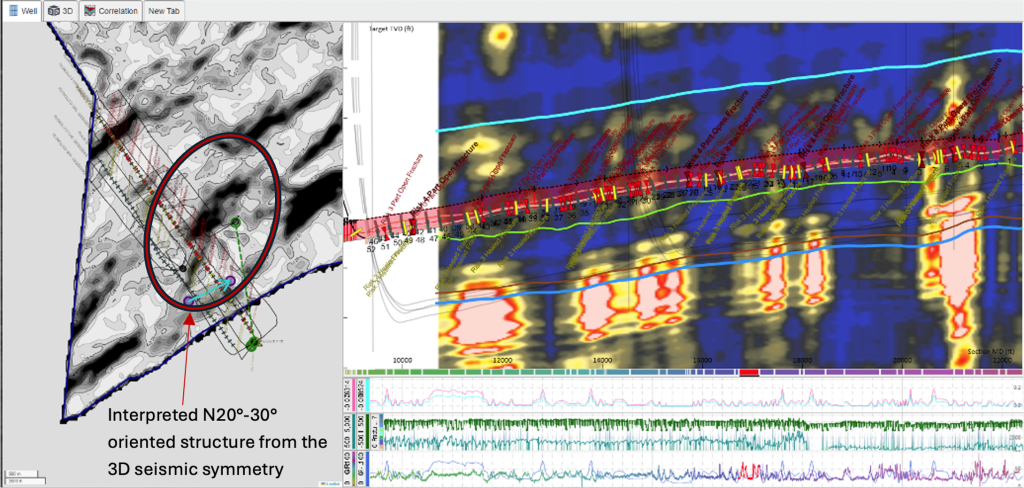
Image in ZoneVu: Left – Map View: Displays the two wells with the 3D seismic symmetry volume, geologic feature of concern circled in red.
Right – Cross Section View: Shows the symmetry volume in profile with frac design and FMI derived fractures in red text.
Casing Deformation Risk Identification
The Director of Completions identified that faults oriented N20°–30°, like the dark structure shown in Map View above, are often associated with casing deformation. When these faults are misaligned with regional stress (SHmax), as they were in this case, the completions director believes they are more prone to slip during hydraulic fracturing and cause casing deformation. The team monitored offset well pressure in real time and adjusted the frac operations accordingly. They also tracked communication with the lower lying Eagle Ford to protect frac efficiency.
Preventing Screen-outs: ZoneVu Helps Find Root Cause
During the fracs, the team said they began to experience pressure outs, bridges, and screen-outs on the first 7 of 48 stages on the pad. Using ZoneVu’s integration of geosteering, seismic, image logs, and stage-by-stage frac job data, the team quickly eliminated lithology as the cause. By process of elimination, they identified the root cause was the proppant sieve size being too large. There is a direct correlation between mean proppant diameter and fracture aperture required to accept sand without bridging. After discovering the proppant issue, they reduced screen-outs to just one in the remaining 52 stages.
Screen-Out Troubleshooting
Results
- Production averaged at or above type curve across both wells, confirming success in both risk management and reservoir delivery.
- Zero casing deformation events – preserved lateral footage, maximizing reservoir access, and avoided high-dollar remediation and lost production.
- Screen-outs and pressure outs reduced by over 85%
- Total direct cost savings:
- $140,000 – $160,000 from avoided screen-out flushes
- $250,000 – $1,000,000+ in avoided remediation and lost opportunity from prevented casing deformation
Conclusion
Broader Implications
As activity in complex plays like the Austin Chalk accelerates, leveraging platforms such as ZoneVu will be critical for operators to maximize outcomes while minimizing operational and financial risk.